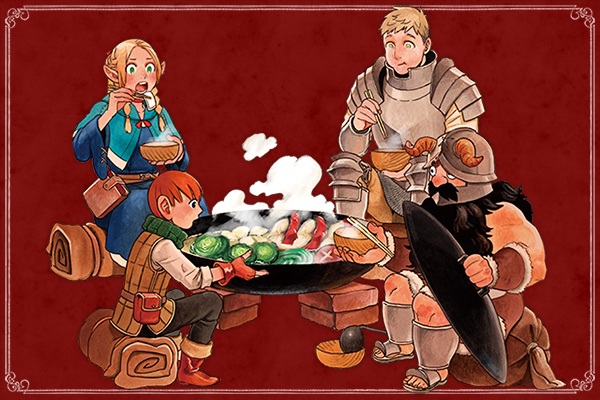
Dungeon Meshi translated into Dungeon Food or with the localized title Delicious in Dungeon. At a glance, it is difficult to figure out what to expect from this series. As the title gives it, it has the feel of a gourmet series focusing on each dungeon food. In reality, Dungeon Meshi offers more than that, but the one thing it does is set the tone for this series. At its core, this series is a comedy gourmet where it can be very lighthearted. In many ways, it’s similar to Campfire Isekai. Even though the story starts with the goal of saving Falin, who is Laios’s sister, the tension never feels overexerted. As it is the party’s goal, it feels like a long-term goal rather than a priority one. It gives the series a feel of an adventure where it is more about the journey than the destination.
One thing that sets Dungeon Meshi apart from a lot of gourmet series is its storytelling and worldbuilding. Ryouko Kui is an outstanding mangaka and how she sets up this series is amazing. Everything introduced has a purpose to it, even the early stuff. The way she can set a lot of this stuff up but keep the series true to itself about it being a comedic gourmet adventure is outstanding. This allows the series to have tone switches when the need arises to be dark, but it is able to switch back to something lighthearted at a moment’s notice. It is a lot like Golden Kamuy in that way, where the tone switches are executed so well.
The series does a great job of using many things you see in fantasy & JRPGs that involve exploring dungeons with parties. At the same time, the worldbuilding is authentic, as it is more of a case of show rather than tell. It is able to be concise and not have unneeded exposition to the reader.
One of the core themes in Dungeon Meshi is one’s desires and mental health. As in many series, dungeons resemble a place where you can achieve stuff from treasures or even more. As conquering the dungeon in this series can lead to one achieving what they want most. But in this series, that is not a good thing because sometimes achieving what you desire can lead to one’s own demise. Also, how one’s desires are only there in the moment and how you will keep wanting to achieve more and more desires and satisfaction until it breaks you. As with anything in life, there is balance.
This leads to the next theme, which is balance. Every time you take something, you must give back. Indulging too much can lead to one’s demise. This can be shown well in terms of the character’s health, as this is a gourmet series. But also when indulging in one’s desires. You need to take care of yourself and those around you. Which is one of the core beliefs Senshi has, which is what he calls looking after the younger generation. As his older dwarves looked after him, now he is doing just the same. Also, balance is shown as the core of the dungeon’s construction and deconstruction. Every time you take, you must give back.
Cultural differences and boundaries are a big element in this series, as each member of the party resembles a different race. It shows how the party cooperates with each other. We can see how the divide between elves and dwarves has an effect initially when Marcille and Senshi join initially. Even with that, the series is about respecting each other because we each have our own desires and fears. The party learns how to come to terms with that as the adventure continues.
If you are coming from having watched Season 1 of the anime and are wondering about the art, well, the art is absolutely top of the line. In detail, paneling and immersion. Overall, Dungeon Meshi is one of those manga that you must give a shot if you love fantasy or gourmet. It tells a nice, concise story that knows when it is time to wrap it up but also feels very satisfying when it is done. Consume Dungeon Meshi and then Spread the word about it to others.